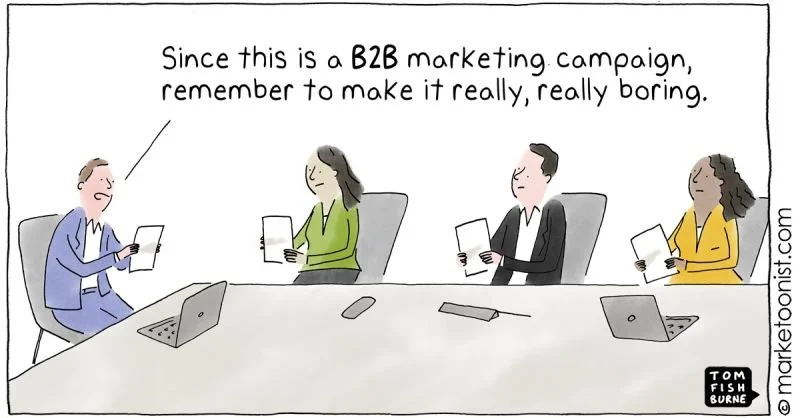
B2B is B2C and B2C is B2B.
So, I’m going to do what my girlfriend tells me to do and write my ramblings here instead of (or as well as) on LinkedIn. LinkedIn is currently the only social network (if it actually counts as that) I really use (bar sporadic Instagram stories. Or reels, I’m not even sure), so when I tend to see/read/hear something, my default is to post it on LinkedIn, where it is instantly devoured by the algorithm and lost forever. Here, it is arguably more permanent. For the benefit of, well, me.
Anyway! I digress.
Jessica Jensen, CMO of LinkedIn, was a guest on Uncensored CMO recently, and the episode is an excellent one. They cover everything from B2B marketing to the LinkedIn algorithm, and personal brand building to people management. But what I wanted to ramble about was one of the first points in the conversation, which is the difference between B2C and B2B marketing.
Or, as Jessica puts it, B2P – business to people. That one is new to me, but I like it very much. I don’t know how long I, and many others, have been saying it, but you are not marketing to a company. There is a human on the receiving end. A living, breathing human who is full of emotions, just like you.
The kinds of ads that resonate with them are the same kind of ads that resonate with “A Consumer™” who is buying a new pair of jeans, headphones or TV. As Jessica puts it, “B2P buying decisions are made on a fusion of rational and emotional factors, no matter if you're buying a car, a bag of Doritos or a SaaS product.”
Or, as Bruno Bertini, CMO at 8x8, says;
“Look at B2C CMOs: they live in constant dialogue with their customers. Every tweet, review or TikTok is unfiltered feedback. They have to earn attention by sparking emotion, not just listing features. They know buyers want to feel something. B2B isn’t different. The CIO scrolling LinkedIn at lunch is the same person scrolling Instagram at night. If they expect connection, creativity and authenticity as consumers, why would they settle for less at work?”
I love that more and more people are realising that emotions can be used in B2B advertising as much as they can be used in B2C. I’m loath to use those terms, as they’re essentially redundant. At least when we’re talking about raising awareness. Take a step or two down the funnel, and then you’re talking about product marketing. Which, unfortunately, is what most of “B2B marketing” has been, until recently. We all know that 95% of buyers aren’t in the market right now, so why do we continue blasting feature-heavy ads?
“Spots of product info is not how you nurture buyers.”
Amen, Jessica. Amen.
I wish I could remember who, but someone interviewed again on Uncensored CMO, suggested that it’s arguably more emotional to buy a solution or product for a business (B2B) than it is to buy something for yourself (B2C); it’s more expensive, your decision impacts more people, and you are responsible for it. I’m not sure I fully believe this, but it’s not wrong, either. It stuck in my mind, so it obviously struck something in me.
The point, and I do have one, is that advertising must be emotional. No matter if you’ve been placed in the B2B or B2C box. And if you’re in the B2B box, your advertising should not be “user, need, value prop, some product specs and performance data”.
“We forgot something important: Buyers—whether they’re singular humans or teams of decision makers—are still people. Nobody falls in love with a feature list. They fall in love with a story. They fall in love with trust. They fall in love with how a brand makes them feel (and of course delivers). They may be wowed by new features or bells and whistles, but a software update won’t make their soul sing. And we, as humans, want our souls to sing.”
There is a wealth of research out there that proves how emotional advertising works. It doesn’t matter which box you’re in; you’re targeting a human.
Get to know them. Understand them. Find out what annoys them, what frustrates them, and what they wish they had. Then create something that they recognise. And, ideally, make them laugh.
Then keep doing it. And keep doing it. Compound that shit. So that when they are in the market to buy, you’re top of mind.