Prattle & Jaw

Two blogs about a whole lot of nothing

Filtering by Tag: Marketing

B2B is B2C and B2C is B2B.

So, I’m going to do what my girlfriend tells me to do and write my ramblings here instead of (or as well as) on LinkedIn. LinkedIn is currently the only social network (if it actually counts as that) I really use (bar sporadic Instagram stories. Or reels, I’m not even sure), so when I tend to see/read/hear something, my default is to post it on LinkedIn, where it is instantly devoured by the algorithm and lost forever. Here, it is arguably more permanent. For the benefit of, well, me.

Anyway! I digress.

Jessica Jensen, CMO of LinkedIn, was a guest on Uncensored CMO recently, and the episode is an excellent one. They cover everything from B2B marketing to the LinkedIn algorithm, and personal brand building to people management. But what I wanted to ramble about was one of the first points in the conversation, which is the difference between B2C and B2B marketing.

Or, as Jessica puts it, B2P – business to people. That one is new to me, but I like it very much. I don’t know how long I, and many others, have been saying it, but you are not marketing to a company. There is a human on the receiving end. A living, breathing human who is full of emotions, just like you.

The kinds of ads that resonate with them are the same kind of ads that resonate with “A Consumer™” who is buying a new pair of jeans, headphones or TV. As Jessica puts it, “B2P buying decisions are made on a fusion of rational and emotional factors, no matter if you're buying a car, a bag of Doritos or a SaaS product.”

Or, as Bruno Bertini, CMO at 8x8, says;

“Look at B2C CMOs: they live in constant dialogue with their customers. Every tweet, review or TikTok is unfiltered feedback. They have to earn attention by sparking emotion, not just listing features. They know buyers want to feel something. B2B isn’t different. The CIO scrolling LinkedIn at lunch is the same person scrolling Instagram at night. If they expect connection, creativity and authenticity as consumers, why would they settle for less at work?”

I love that more and more people are realising that emotions can be used in B2B advertising as much as they can be used in B2C. I’m loath to use those terms, as they’re essentially redundant. At least when we’re talking about raising awareness. Take a step or two down the funnel, and then you’re talking about product marketing. Which, unfortunately, is what most of “B2B marketing” has been, until recently. We all know that 95% of buyers aren’t in the market right now, so why do we continue blasting feature-heavy ads?

“Spots of product info is not how you nurture buyers.”

Amen, Jessica. Amen.

I wish I could remember who, but someone interviewed again on Uncensored CMO, suggested that it’s arguably more emotional to buy a solution or product for a business (B2B) than it is to buy something for yourself (B2C); it’s more expensive, your decision impacts more people, and you are responsible for it. I’m not sure I fully believe this, but it’s not wrong, either. It stuck in my mind, so it obviously struck something in me.

The point, and I do have one, is that advertising must be emotional. No matter if you’ve been placed in the B2B or B2C box. And if you’re in the B2B box, your advertising should not be “user, need, value prop, some product specs and performance data”.

“We forgot something important: Buyers—whether they’re singular humans or teams of decision makers—are still people. Nobody falls in love with a feature list. They fall in love with a story. They fall in love with trust. They fall in love with how a brand makes them feel (and of course delivers). They may be wowed by new features or bells and whistles, but a software update won’t make their soul sing. And we, as humans, want our souls to sing.”

There is a wealth of research out there that proves how emotional advertising works. It doesn’t matter which box you’re in; you’re targeting a human.

Get to know them. Understand them. Find out what annoys them, what frustrates them, and what they wish they had. Then create something that they recognise. And, ideally, make them laugh.

Then keep doing it. And keep doing it. Compound that shit. So that when they are in the market to buy, you’re top of mind.


Why you should increase brand and content marketing budgets during a crisis – not cut them

Did a recently laid-off content marketer write this? Yes, she did. But that’s neither here nor there. The crux remains the same; the best time to pull ahead is when everyone else is pulling back. In plain English, during a crisis, you should not cut brand and content budgets; you should increase them. 

This blog post will regurgitate a lot of words and sentences you’ve probably (hopefully) read before, but if that’s not what blogging is, I don’t know what is.

Here we go.

Brand and content? Are you nuts, Sheila?

TL;DR

Brand and content marketing are solid financial investments that have been proven to increase ESOV and sales in the long term. In times of crisis, companies often cut brand and content marketing budgets because they’re focused on the short term instead of the long term. This has been proven to be damaging for business post-crisis. To reverse this, reverse the action; do not cut brand and content marketing budgets.

There aren’t that many business clients that will say ‘You know what, I’m comfortable signing a contract with a company that I’ve hardly ever heard of before’.”

No one wants what you’re selling

Let’s start at the very beginning, and what a fun place it is to start. 

Even at the best of times, 95% of your customers are not ‘in-market’ to buy whatever it is you’re selling, but only 8% of your marketing budget is spent on brand awareness. 

What does this mean? It means no one wants what you’re selling, so stop trying to do a hard-bottom-of-the-funnel-sell with 92% of your budget to that 95% because they simply don’t care. 

What can you do? You could up that pitiful 8% and focus on building brand awareness and stickiness and all that jazz through targeted content so that when that 95% are ready to buy, who do they remember? You.

Maintaining your budget through this recession and seeing the long-term picture will grow your market share significantly as we come out of this recession, and if you’re smart and bold enough to increase budgets during this recession, the post-recession growth you’ll experience will set up your brand for the long term. The data is clear.”

B2B2C2B2 – whatever, it’s all the same

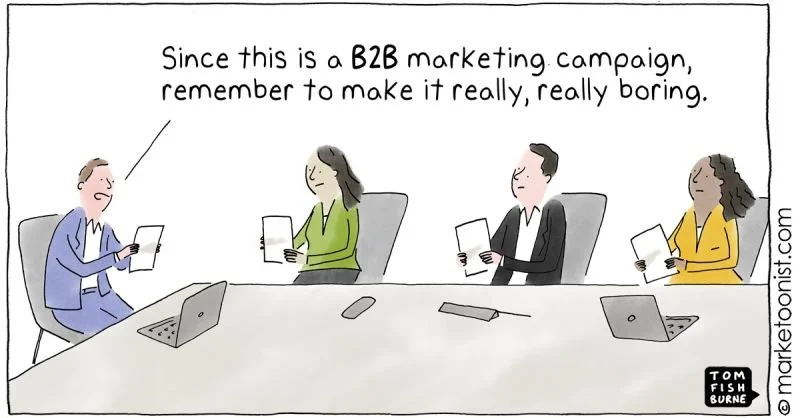
More B2B marketers are beginning to realise that it doesn’t really matter if you’re in the B2B or B2C marketing game because whichever you’re doing there’s still a human being at the other end. Because of this astounding revelation, we’re seeing a shift towards more creative B2B marketing campaigns, with them adopting tenets typically associated with traditional B2C marketing, like storytelling or, I dunno, whimsical OOH ads.

About bloody time, if you ask me. I remember, way back when I was a dewy-eyed marketer, furtively talking with colleagues over a sneaky fag about B2C2B when it was considered, like, totally whack to think that you could just maybe possibly use some of the same tactics of B2C marketing for B2B because, well, humans. Anyway. The penny is dropping, and I am here for it. 

But why am I talking about this? Because it’s so refreshing to see traditional B2B marketing putting thought and resources into beautiful brand marketing. That CFO/engineer/office manager? They’re still (doom) scrolling through Instagram/TikTok/Twitter as well as LinkedIn, you know. They’ve still got eyeballs to get in front of and emotions to blackmail. Or influence or whatever. 

Lol Gregory, we’ve got words like product and sales written on the board, we don’t need “brand”

As MarketingWeek says, “The shift to brand [marketing] will benefit businesses, since brand 1) increases long- and short-term sales, 2) improves pricing power, 3) reduces talent acquisition and retention costs, 4) unlocks growth in new categories, and much more.” 

In fact, brand awareness is so hot right now that it’s the top priority for marketers across all media channels, with customer acquisition cited as the second most-valued goal. 

So we agree. No one wants what we’re selling even in the best of times so we should focus on brand awareness which we all love because we recognise its importance for long-term benefits.

Sounds good, right? 

So why do we keep seeing brand and content marketing budgets slashed whenever we stumble into a crisis?

Cutting marketing costs will decrease brand awareness, search result ranking, and brand loyalty. This leaves plenty of room for competitors to fill the void and take the lead in the market.”

A tale as old as time

It’s been proven time and time again that the best strategy to adopt during downturns is to continue – and even increase – marketing investments in order to capitalise on long-term ROI (as a pleasing bonus, advertising gets cheaper because competitors are pulling out. What’s not to like?).

I know, I know, it’s reductive, and the situation is different for every business, but let’s make sweeping generalisations here because it’s my blog and I can. 

So far, I’ve worked through two crises. First, there was the joy of COVID, and now this recession that’s been thoughtfully slapped onto the end of it by, well, COVID itself and by everyone freaking out about it. 

Both times, I saw the company I was working for slash marketing budgets immediately. Unfortunately for me, both times, the slashing has focused on the fluffy ethereal marketing that some people struggle to understand the value of; brand and content. 

There is an idiot move at the top of the agenda of all those who do not understand history. They see marketing as a cost. Advertising as a luxury. And brand building as the ultimate vanity. Ergo, when times get tough it’s obvious that the first thing to go is the esoteric brand budget and not performance marketing with the proven and immediate ROI.”

Sad face.

Here’s some research based on interviews with 700 CEOs and CMOs by Clear M&C Saatchi. It highlights four factors that limit businesses in a crisis:

  1. Strategy is stuck in the boardroom

  2. Alignment exists on goals but not on tactics

  3. Too much focus on the short term

  4. Marketing is over-stretched in terms of capacity and capability

Now all four factors are pretty eye-roll worthy, and God knows we can all relate, but I’ll focus on number three, that pesky short-term silliness. 

I get it. It’s a crisis; let’s light a fire under people’s asses and get ALL THE LEADS. But no one wants your product, remember? Why, when they’re in the same storm you’re in, would they suddenly decide to spend their precious cash on your product when they didn’t even want it in the first place?

“If your boss tells you ‘I want all of our marketing initiatives to show a positive ROI within the next two months’ you’ve lost the game before you’ve even started it. You are mis-measuring what success means and therefore you are going to mismanage your marketing activities. There is a lot of that happening and it needs to change.”

Yes, short-term savings are essential and might give you a good-looking ROCE during the crisis, but businesses that don’t falter and instead continue to invest in brand throughout a crisis will ultimately realise long-term profitability after the crisis. When things calm down again, you’ll have edged out in front of your competitors – thanks partly to ESOV – and there you shall stay and reap the rewards for doing the right thing. As Mark Ritson said, it’s a tactical challenge but a strategic opportunity.

Brands are not much defence when the shit hits the fan, but brands and brand equity are useful in the second phase where we begin to see, at the end of the recession, a move towards growth and normality. The acceleration of a strong brand is much greater than less strong brands – that’s why you should invest in them in a recession because they will return in terms of a growth catalyst as we come out of it.”

And then she said … CONTENT MARKETING!

So what’s the conclusion? 

This might not come as a surprise, but don’t cut your brand and content marketing budgets during a crisis. They are not nice-to-haves; they are strategic initiatives that can create a huge amount of value for companies in the best of times and in the worst of times.

Now’s your chance to steal all that market share from your competitors. To stand out. To be remembered. Invest for the future. Not now. That’s why it’s called investment. It’s for the future. You want to be there, top of mind for your target customers, so that when they are ready to fork out for whatever you’re offering, they not only think of you, but they can’t avoid you because you never went away. 

Can’t afford to increase budgets? That’s OK. Just don’t cut. Instead, realign, reassess and repurpose. 

  • Realign based on what the competition is doing and what the market looks like

  • Reassess your customer needs and pain points and adjust your strategy

  • Repurpose existing content to fit new tactics and save costs

Work on pushing up that ESOV while everyone else is off wringing their hands and by the time this is all over, you’ll be top of mind and ready to sell.

Boom. 

Copyright © 2026, Lara Mulady. All rights reserved.